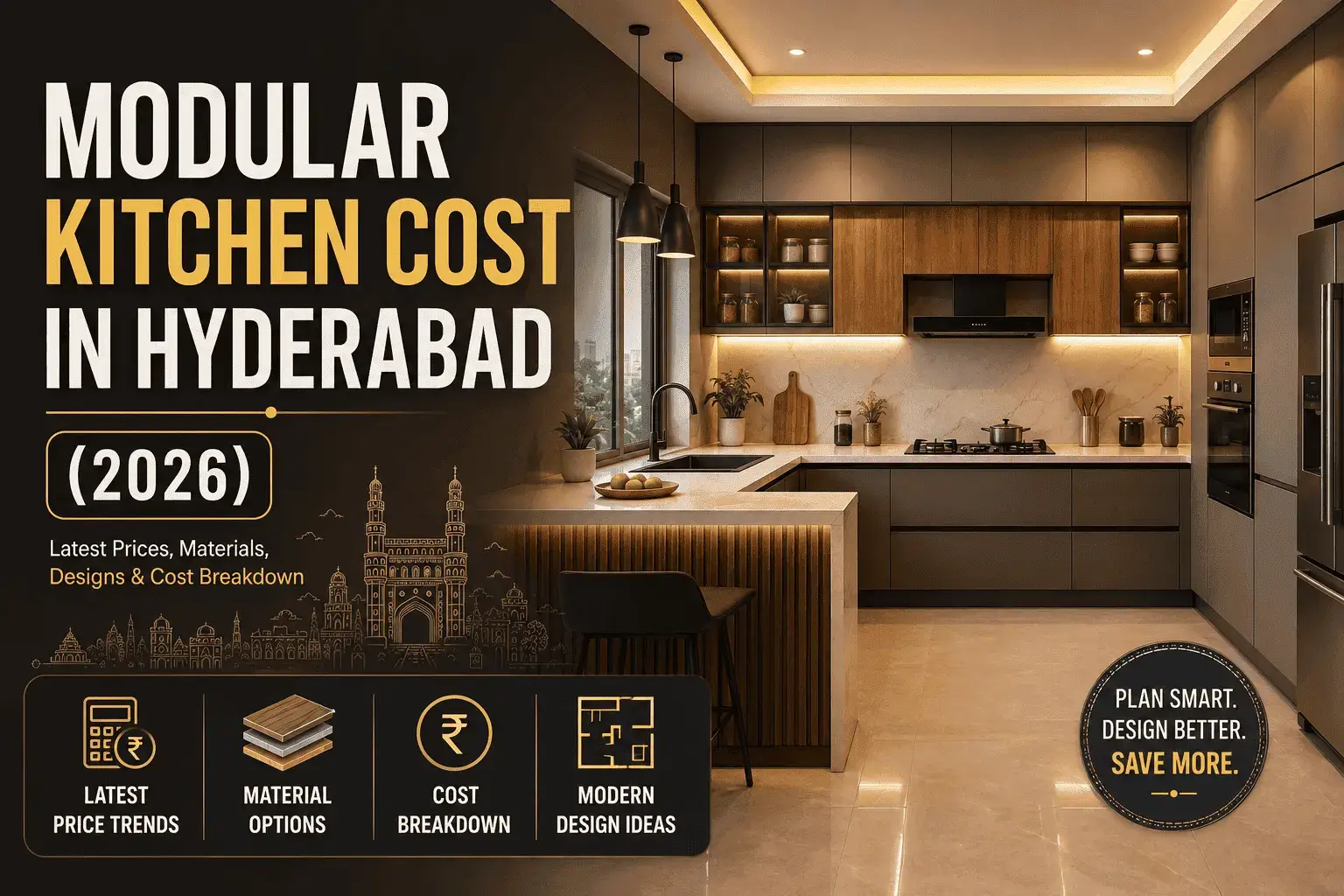
Modular Kitchen Cost in Hyderabad (2026)
How to Guides



The most unforgettable moment in your life, the day of your housewarming ceremony, when your waiting finally ends. Everyone gathers in the kitchen first, and the simple ritual of boiling milk is often the moment the house starts to feel like your home. While you are standing there, you think of your daily routines, family meals, and countless memories that will unfold here.
Naturally, the kitchen becomes the first space you plan and often the biggest interior investment. But once you start discussing your interior design plans, the confusion begins. Every estimate looks different, and you start wondering, Why does the cost of a modular kitchen vary so much?
The answer lies in the kitchen size, layout, materials, finishes, hardware, storage requirements, and appliance integration, all of which determine the final price.
Understanding Kitchen Layouts & Their Cost Impact
When homeowners start planning a modular kitchen, the most important design decision depends on the layout. It quietly determines how your kitchen will function and how much you will eventually spend. It governs how you move through the space, how much storage you can create, how efficiently daily routines flow, and how much cabinetry, hardware, and accessories your kitchen will actually require.
Two kitchens with the same finishes can end up with completely different prices simply because their layouts demand different levels of planning and execution
Straight Kitchen
A straight kitchen follows a single-wall layout, in a single continuous line. Since cabinetry, hardware, and countertop requirements are concentrated in one direction, usually the most cost-efficient. In a straight kitchen, you can use accessories which include SS baskets, hinged cabinets, and granite or quartz countertops. Appliances like a microwave, hobs, and a chimney can be included in this design.
Storage includes:
Base units
Wall cabinets
Limited tall storage
Essential pull-outs and organizers
Its biggest advantage is efficient use of space while reducing the overall costs; it is more common in 1 BHK apartments.
L-Shaped Kitchen
This is often the layout homeowners imagine when they think of a modern modular kitchen. Designed across two connected walls, an L-shaped kitchen creates a natural flow between cooking, preparation, and storage areas while keeping movement comfortable.
It remains one of the most preferred layouts because it balances functionality, storage capacity, and visual openness.
Typical storage includes:
Extended base and wall units
Corner storage
Tall units
Integrated accessory options
This layout works especially well for families and everyday kitchen routines; it is a great choice for 2 BHK and 3 BHK houses.
U-Shaped Kitchen
If you prioritize maximizing storage and creating dedicated work zones, a U-shaped layout offers exactly that. Designed across three sides, this layout creates more countertop area and significantly increases cabinetry capacity. But more storage also means more cabinetry, additional hardware, and more internal accessories.
Storage includes:
Extensive base and wall storage
Multiple tall units
Corner storages
Premium organisers and accessories
This layout is generally preferred for larger kitchens, such as 4 BHKs and Villas.
Island Kitchen
An island kitchen introduces a central workspace that becomes more than just a counter; it turns into a place for conversations, entertaining, casual dining, and everyday gathering. This layout is commonly seen in villas and luxury homes where space allows for greater flexibility and openness.
Typical features include:
Large cabinetry layouts
Additional island storage
Premium countertop finishes
Integrated lighting and appliance planning
Because of the additional cabinetry, surfaces, electrical coordination, and execution involved, island kitchens typically represent the highest investment range
What Does A Modular Kitchen Cost Include?
When it comes to kitchen interior design, it works differently. Usually, costing does not begin with cabinets or materials; it starts with proper communication. You sit with a designer, explain the way you live, discuss how you cook, how much storage you want, how many people use the kitchen, and what your expectations are.
Based on your suggestions, the designer develops a 2D layout, plans storage components, explores material and finish options, and recommends hardware based on functionality and your preference.
Only after all these decisions come together do quotations begin to be issued; first, the designer has to understand your needs and preferences.
Here is what a typical modular kitchen quotation usually includes:
1. Cabinets & Storage
When you start planning your kitchen, it is easy to focus on colours and finishes first. But what truly shapes your everyday routine is storage behind. They usually form a major part of your kitchen investment because they determine how comfortably and efficiently you use the space.
Base Units – Lower cabinets designed for everyday cooking essentials and frequently used storage.
Wall Cabinets – Upper cabinets that maximise vertical space while keeping essentials within easy reach.
Tall Units – Full-height storage ideal for pantry organisation and integrated functionality.
Loft Storage – Additional overhead storage for items used occasionally and to make better use of available space.
2. Countertops
Countertops were among the most visually appealing elements in the kitchen. Countertop materials influence both the look and cost of your kitchen. The material you select shapes both everyday performance and overall cost. There are basically three countertop materials that are widely preferred.
Granite – it is a widely preferred countertop material known for its natural appearance and heat resistance.
Quartz – An engineered surface valued for its premium finish, consistency, and low-maintenance performance.
Premium Surfaces – High-end countertop materials chosen for their refined aesthetics, durability, and elevated overall look.
3. Cabinet Shutters & Finishes
Laminate – A versatile finish which was available in a wide range of colours, textures, and patterns, making it a popular choice across design styles.
Acrylic – Known for its smooth, glossy appearance that creates a clean and modern look with a premium feel.
PU (Polyurethane Finish) – A painted finish that offers a smooth surface and refined appearance for a more elevated aesthetic.
Veneer – A natural wood finish chosen for its rich texture, which brings warmth and sophistication into the space.
4. Hardware
You can tell a well-designed kitchen within seconds, not by how it looks, but by how it moves. The cabinet closes softly when you close it a hundred times, too. The drawer opens smoothly even after years of use. The overhead shutter lifts with ease and stays exactly where you need it. Here is all the information about the hardware behind a seamless kitchen design:
Hinges – Enable smooth opening and closing of cabinet shutters while supporting durability over time.
Drawer Channels – Allow drawers to glide smoothly and handle daily storage with ease.
Lift-Up Mechanisms – Create easy access to overhead cabinets while enhancing convenience and usability.
5. Storage Accessories
On the first day of your new kitchen, you feel everything is perfectly organized.
Then, everyday routines begin.
Suddenly, you find yourself searching for a spoon in one drawer, reaching deep into corners for cookware, and moving three things just to access one. That is when you realize a great kitchen is not about how much storage you have, but how perfectly it is organized.
Storage accessories are designed to make everyday movement smoother, helping everything stay organized, accessible, and easy to use. Some common accessories are:
Cutlery Trays – Keep everyday utensils neatly separated and easy to find.
Tandem Drawers – Deep and organized storage for cookware, containers, and larger essentials.
Corner Units – Convert difficult corner spaces into accessible storage.
Pull-Out Units – Bring stored items within easier reach for better organization.
These details may seem small during planning, but they are often what make a kitchen feel modular long after installation.
6. Sink & Faucet
When you start using your kitchen every day, you realise how your sink and faucet become part of your daily routine, from preparing meals to washing ingredients and cleaning vessels after cooking. Their size, placement, finish, and functionality play an important role in how comfortable and easy to use your kitchen is.
Most kitchen quotations may include the sink and faucet, depending on the project scope, with costs varying based on material, design, finish, and installation requirements.
7. Lighting & Electrical
The right lighting, which helps to improve visibility while cooking, makes storage easier to access and supports while preparing dinner. The main lighting provides overall illumination for comfortable everyday use. Under-cabinet lighting improves visibility across preparation areas. Pendant lighting focuses light while creating visual interest around islands or dining zones.
If it is an accent or cabinet lighting, it highlights design details and creates a more refined ambience. Depending on the project scope, a kitchen quotation may include lighting provisions, electrical coordination, and appliance points that support both functionality and comfort.
Modular Kitchen Cost In Hyderabad (2026)
Budget Tier | Finish Type | Estimated Cost | Best For | Layout |
Basic | Laminate | Starts from ₹ 5 L | 1- 2 BHK Apartments | Straight / L-shaped |
Mid-range | Acrylic / Laminate mix | Starts from ₹ 7L | 2- 3 BHK homes | L / U-shaped |
Premium | PU/Veneer/Acrylic | Starts from ₹ 12L+ | Villas & Luxury Apartments | U / Island |
What Is Usually Not Included?
A kitchen quotation may look complete at first, but certain supporting work is usually handled separately and can affect the final price.
Here are the items that are commonly excluded:
Appliances – Usually one of the highest additional costs. Items such as the hob, chimney, oven, refrigerator, dishwasher, and other built-in appliances are generally quoted separately based on brand and specifications.
Civil Work – Only minimal civil work required for installation is typically covered. Larger changes, such as wall modifications, flooring updates, tiling, or structural adjustments, are usually excluded.
Plumbing Modifications – Any relocation of water lines, drainage points, or changes to the existing plumbing layout are not part of the interior design.
Gas Connections – Gas pipelines, utility connections, and related installation work are generally handled outside the modular kitchen scope.
Common Mistakes Homeowners Make While Budgeting
When you choose one finish over another, skip an accessory, postpone appliance planning, or select the lower quotation, thinking you will rectify it later. More often than not, it seems like a series of small compromises that lead to additional costs, redesigns, and missed functionality.
Here are some of the most common mistakes homeowners make while planning their kitchen interior:
Choosing Only Based On the Lowest Quote
Finalising with the lowest quotes may feel cost-efficient in the beginning stage. But after a few months, when finishes start peeling, hinges begin loosening, and materials start showing signs of fungal growth, you realise the original savings may not feel worth it anymore.
The difference is often not in the visible design but in the materials, hardware quality, execution standards, and what was included in the quotation. Instead of choosing solely on final pricing, compare itemized BOQs and long-term value before making a decision.
Ignoring Hardware Quality
You may not think about hardware while quoting, but you notice it every day after moving in, in the way drawers glide, cabinets close, and shutters open. Choosing better hardware often creates a smoother experience and improves long-term durability.
Missing Accessory Costs
Storage accessories are often considered a choice during planning, but it is crucial not to ignore them later. Features like pull-outs, organizers, and tandem drawers can quietly increase the final budget if they are not considered from the beginning.
Not Planning Appliance Sizes
You may think appliances can be decided later, until the refrigerator feels oversized or the oven no longer fits the planned layout. Planning appliance sizes early helps avoid redesign, rework, and additional costs during execution.
Prioritizing Aesthetics Over Functionality
It is easy to choose what looks beautiful during planning, but once you start using it every day. A kitchen should support how you cook, move, and make your everyday life easier. The best kitchens balance aesthetics with functionality.
Design Your Modular Kitchen With Tint Tone & Shade
Months after moving in, you will not remember the quotations you compared, but you will notice how your kitchen feels every single day.
That is why at Tint Tone & Shade, we do more than design kitchens; we create spaces around how you live.
From custom-designed kitchens instead of catalogue solutions to transparent pricing, itemised BOQs, durability-focused material selection, and end-to-end execution, every decision is planned with clarity and long-term value in mind.
Book a consultation with us. Let’s design a kitchen that feels just as good years later as it does on day one.
Frequently Asked Questions (FAQs)
1. Which material is best for kitchen cabinets?
There is no single best material; the right choice depends on your budget, usage, and durability expectations. BWP plywood is commonly preferred for kitchens due to its moisture resistance and long-term performance.
2. Is quartz better than granite for kitchens?
Both are popular choices. Granite is valued for durability and natural appearance, while quartz is preferred for its consistent finish, premium look, and lower maintenance.
3. Are appliances included in the modular kitchen cost?
In most cases, appliances are quoted separately. Items such as the hob, chimney, oven, refrigerator, dishwasher, and other built-in appliances are usually not included unless specifically mentioned.
4. Is BWP plywood necessary for kitchens?
BWP plywood is often recommended for kitchens because of its better moisture resistance and durability. However, the right material selection depends on kitchen conditions and project requirements.
5. How do I compare modular kitchen quotations?
Do not compare only the final price. Review the itemized BOQ, material specifications, hardware brands, inclusions, exclusions, and execution scope to understand the actual value offered.
Similar Topic